
Special Considerations
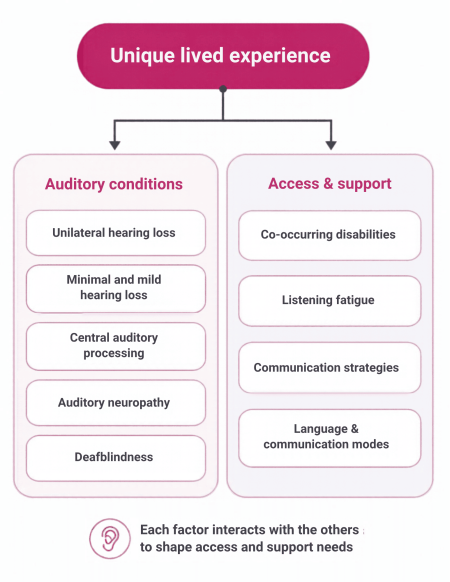
Every deaf or hard of hearing individual has a unique lived experience shaped by a variety of personal, environmental, and auditory factors. We describe several auditory conditions that may affect language acquisition and communication and present strategies to support equitable communication access.
Unilateral Hearing Loss
Unilateral hearing loss is when there is a hearing loss in only one ear. It presents unique listening challenges that are different from bilateral hearing loss (from Fitzpatrick et al., 2019).
Special Considerations:
- Difficulty with sound localization
- Reduced speech perception abilities in noisy environments
- Loss of interaural time and level differences which may create a safety concern such as when crossing the street
- Increased listening, communication, and educational difficulties as hearing levels decrease in affected ear
- Challenges with UHL
- Affects each person differently, therefore difficult to predict which children will have issues
- Specific clinical guidance for assessment, management, and outcome measurements vary
- Lack of specific professional guidance complicates information provided for families regarding the treatment plan and outcomes for their child
- Clinical uncertainty may be a barrier to follow-through with intervention
RESOURCES
Supporting Success For Children With Hearing Loss | Unilateral Hearing Loss and Learning
www.boystownhospital.org/knowledge-center/classroom-accommodations-children-with-hearing-loss
Minimal and Mild Hearing Loss
Common hearing level definitions:
- Minimal hearing loss = 15 to 25 dB HL
- Mild hearing loss = 25 to 40 dB HL
Special Considerations:
- Individual impact of minimal or mild hearing loss varies
- Assessments in quiet and noise are essential (outcome questionnaires) to understand individual performance in different listening environments
- These students are frequently overlooked in the classroom because they generally appear to hear and they can speak well
RESOURCES
Classroom Accommodations for Children with Minimal or Mild Hearing Loss
www.boystownhospital.org/knowledge-center/classroom-accommodations-children-with-hearing-loss
“Minimal” Hearing Loss: What Does it Mean
www.handsandvoices.org/articles/tech/minimal.html
Central Auditory Processing Disorder
ASHA uses the term Auditory Processing Disorder (APD) to refer to deficits in the neural processing of auditory information in the brain that are not due to higher order language or cognition
Special Considerations:
- Diagnosis is a professional decision by an audiologist based on a combination of case history; basic audiological assessment; other professional assessments; questionnaires; and specialized auditory processing tests
- A normal audiogram does not always indicate normal auditory function
- Treatments for auditory processing deficits include:
- auditory training
- hearing access technology
- language and compensatory strategies
RESOURCES
ASHA clinical practice document
https://www.asha.org/practice-portal/clinical-topics/central-auditory-processing-disorder/
Jeremy talks about his experiences with having CAPD
https://www.youtube.com/watch?v=UFtT0SK9Idk
Auditory Neuropathy Spectrum Disorder
Auditory Neuropathy Spectrum Disorder (ANSD) is a hearing condition where sound may be detected in a typical range, but is not received by the brain for adequate understanding.
Special Considerations:
- Hearing levels can range from typical to profound, but understanding speech can be difficult regardless of classification of hearing levels
- A child may pass a hearing test and still struggle to understand speech, especially in noisy places, because the issue is with clarity, not just loudness
- The only way to identify true auditory neuropathy is through a diagnostic Auditory Brainstem Response
- Challenges with auditory neuropathy
- It’s hard to predict how it will affect any one person
- Regular check-ins on hearing, speech, language, and overall development are needed, since a child’s needs can change over time
- Deciding on a communication approach, such visual language, spoken language, or a combination, should be based on the individual child.
- Amplification considerations are individualized based on child’s needs.
- Ongoing support and clear information for families make a real difference in how well a child does
RESOURCES
Auditory Neuropathy — NIDCD (NIH)
nidcd.nih.gov/health/auditory-neuropathy
ASHA Practice Portal: Auditory Neuropathy Evidence Map
https://apps.asha.org/EvidenceMaps/Maps/
Deafblindness
Deafblindness is a condition resulting in combined hearing and vision loss thus limiting access to both auditory and visual information.
Special Considerations:
- Most individuals have some usable vision or hearing
- Dual sensory loss creates major needs in communication, learning, and daily movement
- Deafblind individuals have special challenges with visual and auditory stimuli
- Accommodations may be complicated and personal preferences should be identified and implemented
RESOURCES
An overview of deafblindness
www.nationaldb.org/media/doc/Overview_of_Deafblindness_Infographic_JUL2022_a_1.pdf
National Center on Deaf-Blindness
www.nationaldb.org/info-center/deaf-blindness-overview/
Co-occuring Disabilities
Individuals with auditory deficits who have one or more co-occurring disabilities, including cognitive and developmental delays.
Special Considerations:
- As a sensory input, auditory function must be fully assessed, managed, and accommodated in the context of the other challenges and needs of the individual
- Communication access may required a variety of modes and methods depending on the individual’s preferences and abilities, and situational context
RESOURCES
Communication considerations for those with hearing loss and a co-occurring disability.
www.handsandvoices.org/comcon/articles/deafplus.htm
Supporting students with hearing loss and co-occurring disabilities.
www.successforkidswithhearingloss.com/supporting-students-who-are-deaf-plus/
Listening Fatigue
Listening-related fatigue results from increased and/or sustained effort required to listen
Special Considerations:
- Listening fatigue is common in individuals with hearing loss and special listening needs
- Classrooms and other environments with poor acoustics or high levels of competing noise contribute to listening fatigue
- Listening fatigue may be reduced though added visual accommodations
- Be mindful that visual fatigue results from focused visual attention in speechreading, captions/transcriptions, and other print materials
- Limit time required for auditory and visual attention to developmentally appropriate segments and provide breaks as determined by the needs of the individual
RESOURCES
Vanderbilt Fatigue Scales
www.vumc.org/vfs/vanderbilt-fatigue-scales
Communication Strategies
Communication strategies are designed to support access in different listening environments and with regard for personal preferences. Strategies must be context specific and should consider content, language and vocabulary, communication environment, communication partners, and the communication modes used in the interaction.
Special Considerations:
- Important strategies to enhance communication access include:
- Lighting to highlight lip-reading and facial expression
- Alerting individual prior to communicating to focus attention to talker/signer
- Using clear, intelligible speech
- Providing repetition when requested
- Ensuring RM HAT system is appropriate for individual and working consistently
Top ten communication strategies for teachers
RESOURCES
Ways to communicate with a child with hearing loss
www.successforkidswithhearingloss.com/wp-content/uploads/2011/08/Comm-Options-Overview-Ways-to-Communicate-with-a-Child-with-Hearing-Loss.pdf
Language and Communication Modes
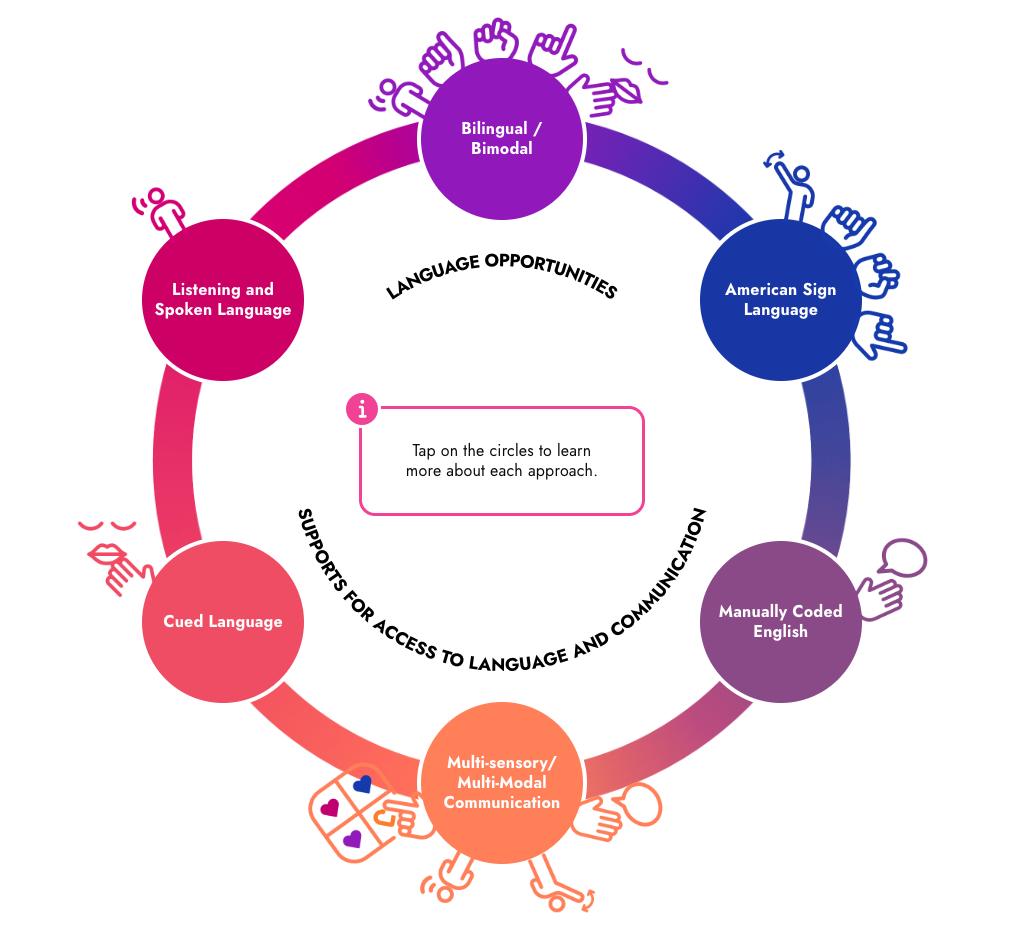
Many deaf and hard of hearing individuals use multiple languages (e.g., English and ASL) and multiple modalities (e.g., listening, speaking, signing) when they communicate. Choice of language and mode generally depends on personal preference, competency in that language and mode, the communication mode used by others, groups vs one to one, familiarity with the context and vocabulary involved, the environment, and the community (e.g., deaf vs hearing or mixed), among other factors).
Special Considerations:
- It is always important to ask and respect the desired communication language and mode used by the individual. Communication modes include:
- listening and spoken language
- signed languages
- cued languages and other signed English languages
- a combination of signed and listening and spoken language.
- Ask in advance for preferred accommodations so that arrangements can be made in advance
Communication & Language Opportunities for Children Who Are Deaf or Hard of Hearing
Utah School for the Deaf and the Blind
RESOURCES
Language and Communication of Deaf and Hard of Hearing Children
www.asha.org/practice-portal/professional-issues/language-communication-deaf-hard-of-hearing-children/
Communication Plans:
www.handsandvoices.org/articles/education/law/complan_faq.htm